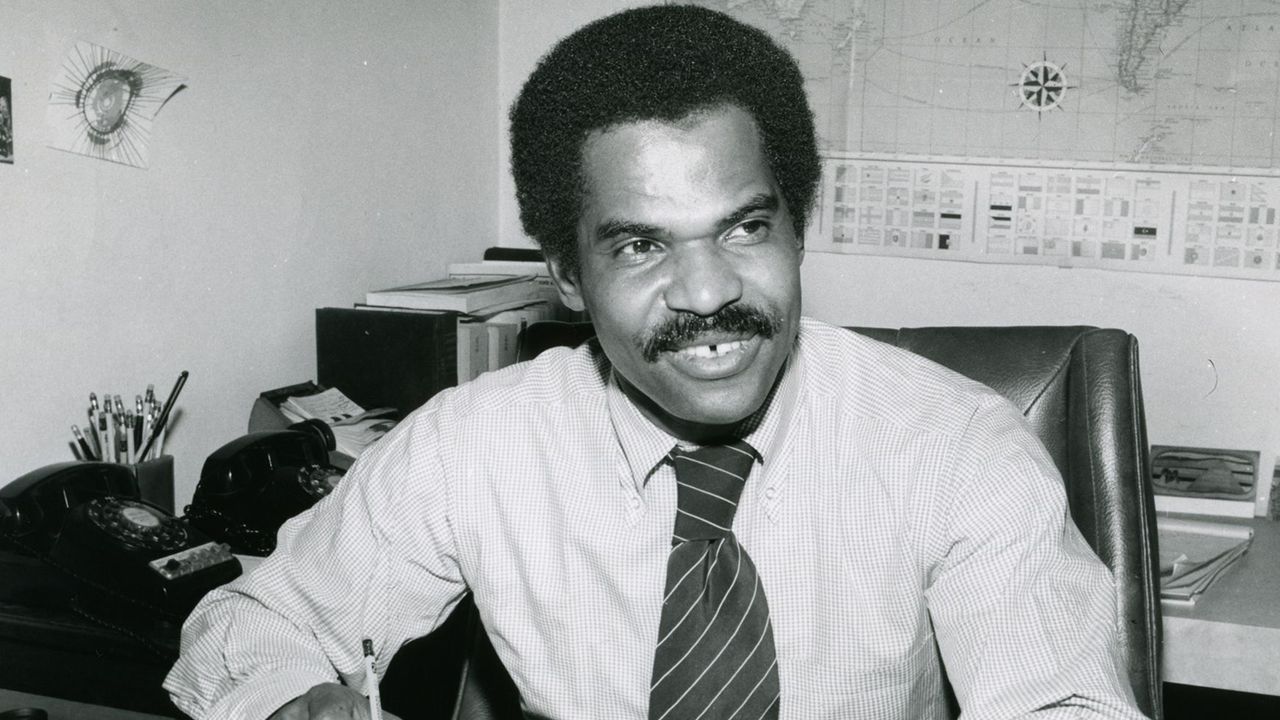
Reginald Lewis
Reginald F. Lewis
“Keep going. No matter what.”
Photo: Unknown / THIRTEEN / Reginald F. Lewis Foundation / Press / editorial use

Why This Person Is Included
Lewis completed the largest overseas leveraged buyout in history at the time, built the first Black-owned billion-dollar enterprise, and wrote an autobiography that has inspired a generation of Black acquisition entrepreneurs. He is known in Black business culture. He is not a household name in America the way that the other men who did comparable deals in the same era are household names. The differential is the curriculum.
The Story
Reginald Francis Lewis was born in Baltimore on December 7, 1942.1 He attended Virginia State University on a partial athletic scholarship, was admitted to Harvard Law School through an unconventional route — the admissions committee waived his application requirement after a summer program — and became a corporate attorney in New York.1 He co-founded a law firm before pivoting to deal-making full time.
His first major transaction was the 1983 acquisition of McCall Pattern Company — a home sewing and publishing firm — for $22.5 million in a leveraged buyout.2 He sold it in 1987 for $65 million, generating a 90-fold return on his personal investment.2 That exit established TLC Group as a credible acquirer and Lewis as a dealmaker who could execute the model: identify an undervalued asset, acquire it with borrowed money collateralized by the target's own assets, improve operations, and exit at a premium.
The Beatrice Acquisition (1987)
On November 30, 1987, Lewis's TLC Group announced the acquisition of Beatrice International Foods for $985 million — at the time, the largest offshore leveraged buyout in American history.23 Beatrice International comprised 64 companies across 31 countries with revenues exceeding $1.8 billion annually, spanning food manufacturing and distribution in Europe, Latin America, and Asia. Lewis moved to Paris to oversee what he called 'the hundred-day sprint' — the first quarter of management that would define the deal's trajectory.
TLC Beatrice International became the first Black-owned company to exceed $1 billion in annual revenues.2 Lewis ran the conglomerate from Paris, restructuring divisions, renegotiating contracts, and improving margins across a portfolio spanning 64 companies on five continents.
Philanthropy and Harvard
In 1987 — the same year as the Beatrice acquisition — Lewis founded the Reginald F. Lewis Foundation to support educational programs for minorities and underprivileged youth and to preserve African American art and culture.4 The Foundation continues to make grants in education, culture, and arts.4
The Reginald F. Lewis International Law Center at Harvard Law School stands as the first building on Harvard Law's campus named after a Black American.4 The Reginald F. Lewis Museum of Maryland African American History and Culture in Baltimore bears his name.
The Autobiography and Its Consequences
Lewis began writing his autobiography before his death. His family completed it with co-author Blair S. Walker; 'Why Should White Guys Have All the Fun?' was published posthumously in 1995.1 It has been cited by Earl Gordon, Robert F. Smith, and many Black acquisition entrepreneurs as the book that introduced them to the LBO model and demonstrated that it was available to them. Lewis died on January 19, 1993, from brain cancer, at fifty — six years after acquiring Beatrice, in the middle of preparing TLC Beatrice for a public offering that would have been the first Black-owned company on the New York Stock Exchange.3
Constraints & Tradeoffs
Access to the Rooms
Lewis operated in the leveraged buyout market of the 1980s — a market built on relationships, reputation, and access to institutional debt that had been systematically constructed by white men for white men over decades. He broke into it not through demographic similarity but through legal precision: his work as a corporate attorney gave him technical mastery of deal structures before he had the capital to execute them. His first major deal, McCall Pattern, was possible because Lewis had spent years building relationships with the financial advisors and bankers who could structure the financing — relationships built one at a time, across a decade, in a market that was not designed to include him.
The Beatrice acquisition required Michael Milken's junk bond financing — the same debt mechanism that financed every major LBO of the 1980s. Lewis's access to that financing came through established relationships and demonstrated deal performance from the McCall exit. Without the McCall track record, the Beatrice financing would have been impossible. The sequence was the strategy.
What Actually Happened
TLC Beatrice and the Legacy
Lewis died on January 19, 1993, at fifty, from brain cancer — in the middle of preparing TLC Beatrice for a public offering that would have been the first Black-owned company on the New York Stock Exchange. His estate and family managed the sale of TLC Beatrice's divisions over subsequent years. The autobiography he was completing at the time of his death was published posthumously in 1995 as 'Why Should White Guys Have All the Fun?' — it remains in print and has been cited by Robert F. Smith, Earl Gordon, and many other Black acquisition entrepreneurs as the text that introduced them to the LBO model.
The Reginald F. Lewis Foundation, established before his death, has made major gifts to Howard University Law School and Harvard Law School, both renamed in his honor. Villa Lewaro, Walker's estate, and the Reginald F. Lewis Museum of Maryland African American History and Culture in Baltimore are among the institutions bearing his name.
Pattern Extraction
Lewis's pattern is the sequential credential: build the technical expertise first (law), use it to access the market (M&A advisory), build the track record in smaller deals (McCall), use the track record to access the financing for larger deals (Beatrice). Each stage created the credential required for the next. The pattern requires patience at each stage — accepting smaller deals when larger ones are visible, because the smaller deal is what makes the larger one possible.
Frequently Asked Questions
- What was Reginald Lewis's highest level of education? ▾
- Reginald Lewis attended Virginia State University on a partial athletic scholarship, then earned his J.D. from Harvard Law School after the admissions committee waived his standard application requirement following a summer program. Harvard Law School is his highest degree earned. ⚠ VERIFY: Year of Harvard Law J.D. completion is not specified in the record.
- What is Reginald Lewis's net worth? ▾
- No independently verified net worth figure is publicly available for Reginald Lewis. Lewis died in January 1993. At the time of his death, TLC Beatrice International — the company he controlled — generated annual revenues exceeding $1.8 billion across 64 companies in 31 countries. Comprehensive estate or personal net worth figures were not disclosed publicly.
- What was the McCall Pattern Company deal, and why did it matter? ▾
- In 1983, Lewis's TLC Group acquired McCall Pattern Company — a home sewing and publishing firm — for $22.5 million in a leveraged buyout. He sold it in 1987 for $65 million, generating a 90-fold return on his personal investment. That exit established TLC Group as a credible acquirer and proved Lewis could execute the LBO model: acquire an undervalued asset with borrowed money collateralized by the target, improve operations, and exit at a premium.
- What was the Beatrice International acquisition, and why was it historic? ▾
- On November 30, 1987, Lewis's TLC Group announced the acquisition of Beatrice International Foods for $985 million — at the time, the largest offshore leveraged buyout in American history. Beatrice International comprised 64 companies across 31 countries with revenues exceeding $1.8 billion annually. TLC Beatrice International became the first Black-owned company to exceed $1 billion in annual revenues.
- What is the book "Why Should White Guys Have All the Fun?"? ▾
- Lewis began writing his autobiography before his death. His family completed it with co-author Blair S. Walker; "Why Should White Guys Have All the Fun?" was published posthumously in 1995. It has been cited by numerous Black acquisition entrepreneurs — including Earl Gordon and Robert F. Smith — as the book that introduced them to the LBO model and demonstrated that it was available to them.