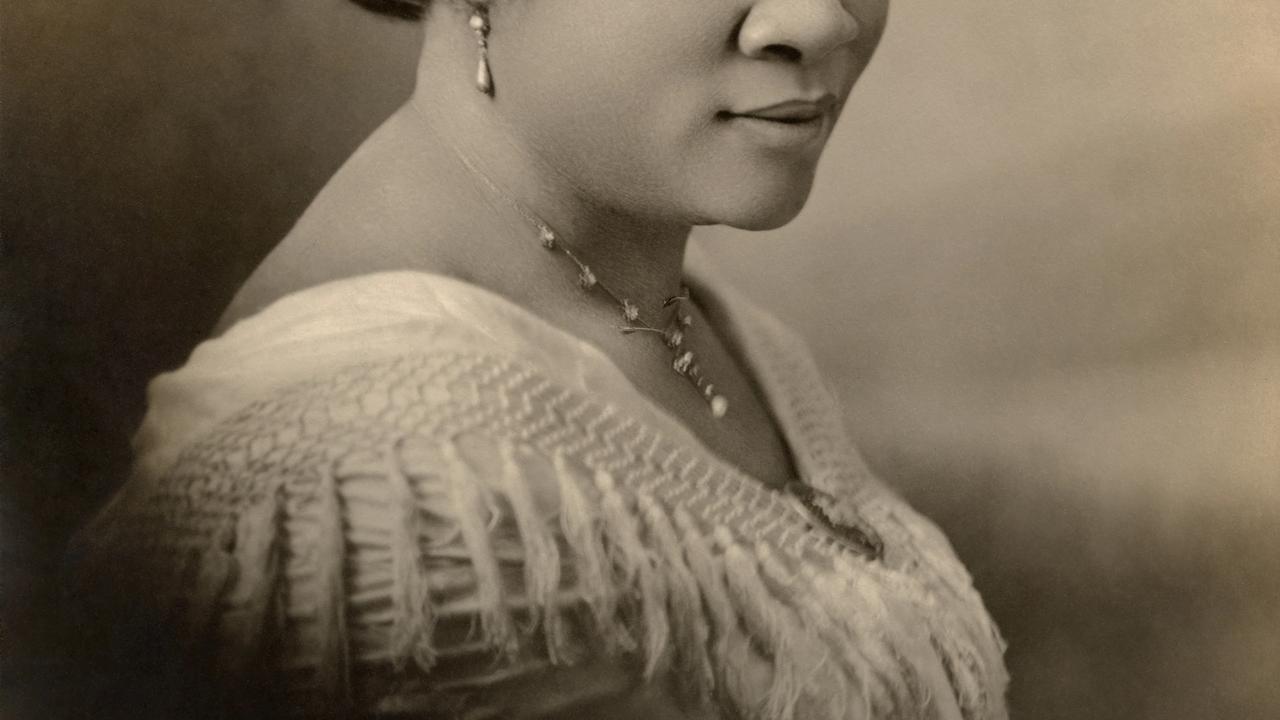
Madam C.J. Walker
Madam C.J. Walker
“I am not merely satisfied in making money for myself. I am endeavoring to provide employment for hundreds of women of my race.”

Why This Person Is Included
You know her name. What most people don't know is the business system — the Walker Agents, the training schools, the 25,000-person sales network she built before direct sales had a corporate framework. She is celebrated as a symbol. Her actual business model — the first national direct sales network in American beauty, built entirely by and for Black women — is the curriculum.
The Story
Sarah Breedlove was born on December 23, 1867, in Delta, Louisiana, to Owen and Minerva Anderson Breedlove — formerly enslaved parents who became sharecroppers after emancipation.1 Both parents died before she was seven. She lived with her older sister Louvenia, worked cotton fields, married at fourteen to escape an abusive household, and was widowed at twenty with a daughter named Lelia.2
She moved to St. Louis to be near her brothers, worked as a washerwoman for eighteen years, and began experiencing the hair loss that was endemic among Black women of the era — a consequence of poor nutrition, scalp conditions, and the absence of hair care products designed for Black hair.1 Around 1905, she developed a hair care formula and began selling it door to door in Denver, Colorado, under the name she took from her second husband, Charles Joseph Walker.
The Walker System
What Walker built was not merely a beauty company — it was a national employment system for Black women.3 She trained 'Walker Agents' in her hair care methods, certified them as practitioners of the 'Walker System,' and sent them out as independent sales agents earning commissions on product sales. By the time Walker died in May 1919, she and her teaching faculty had trained between 20,000 and 25,000 Walker agents.3 These women — laundresses, sharecroppers' wives, domestics — earned more as Walker Agents than any other occupation available to them in 1910.
She held annual conventions for her agents — the Walker Hair Culturists Union of America — that were simultaneously training sessions, business conferences, and political organizing events.1 She incentivized agents who gave back to their communities and spoke on public affairs at every convention. Annie Malone, who operated the Poro College in St. Louis, had been Walker's employer and provided her initial hair care training before Walker developed her own system.2
Villa Lewaro and What Came After
Walker built Villa Lewaro — a 34-room, 20,000-square-foot mansion in Irvington-on-Hudson, New York, thirty miles north of New York City — at an estimated construction cost of $250,000.4 The estate was designed by Vertner Woodson Tandy, the first licensed Black architect in New York.4 Walker used Villa Lewaro to entertain Booker T. Washington, W.E.B. Du Bois, and other leaders of the era — the estate as a deliberate demonstration that Black wealth existed and could be built.
Walker died on May 25, 1919, at fifty-one, from kidney failure and complications of hypertension at Villa Lewaro.2 Her net worth at death has been estimated by various sources as between $500,000 and over $1 million — sources differ, and the Guinness Book of World Records cites her as the first self-made female millionaire in America.5 Her will left two-thirds of future company profits to charitable purposes.2
Her daughter A'Lelia Walker inherited the business and turned Villa Lewaro into a Harlem Renaissance salon for writers, artists, and intellectuals. The Walker Manufacturing Company continued under family management for decades. Villa Lewaro was acquired by the National Trust for Historic Preservation in 2020.4
Constraints & Tradeoffs
Race, Gender, and Capital
Walker built her company in the Jim Crow era without access to bank financing, corporate supply chains, or white-controlled retail distribution. Every structural resource that white-owned beauty companies in 1905 could access — banking credit, advertising in white publications, retail partnerships — was closed to her. She built around these closures by creating her own distribution system (Walker Agents), her own retail network (her agents' homes and salons), and her own advertising medium (her agents themselves, who were walking demonstrations of her product).
A second constraint was specific to the beauty industry of her era: the products available for Black women's hair were either inadequate, damaging, or absent entirely. Walker was not filling an underserved market — she was building the product and the market simultaneously. The product development, the manufacturing, the agent training, and the marketing all had to be created from nothing.
What Actually Happened
First Self-Made Female Millionaire
Walker died on May 25, 1919, at fifty-one, at Villa Lewaro, her Irvington-on-Hudson estate. Her net worth exceeded $1 million — the Guinness Book of World Records recognizes her as the first self-made female millionaire in American history. Her will left two-thirds of future company profits to charitable purposes.
The Madam C.J. Walker Manufacturing Company continued under her daughter A'Lelia Walker's management and remained in operation for decades. Villa Lewaro was sold after A'Lelia's death but later purchased by a preservation organization. The Walker name has been revived in the contemporary beauty market through a licensed brand, and her story was dramatized in the 2020 Netflix series 'Self Made.'
Pattern Extraction
Walker's pattern is the vertically integrated distribution system: when every external distribution channel is closed, build your own. The Walker Agents were not just salespeople — they were the manufacturing output, the retail network, the advertising vehicle, and the community benefit simultaneously. The pattern of creating the infrastructure you cannot access is the most durable insight her story offers.
Frequently Asked Questions
- What was Madam C.J. Walker's highest level of education? ▾
- Madam C.J. Walker received no formal schooling. Orphaned at age seven and put to work in cotton fields, she had no access to education as a child. She taught herself to read and write as an adult. Her business knowledge was built entirely through practice, observation, and self-directed study.
- What was Madam C.J. Walker's net worth? ▾
- Madam C.J. Walker died on May 25, 1919. Her estate at death has been estimated by various sources at between $500,000 and over $1 million. The Guinness Book of World Records recognizes her as the first self-made female millionaire in America. No current net worth figure applies, as she died in 1919.
- When and where did Madam C.J. Walker start her hair care business? ▾
- Around 1905, Walker began developing her hair care formula and selling it door to door in Denver, Colorado. She was operating under the name Madam C.J. Walker, taken from her second husband, Charles Joseph Walker. She established the Madam C.J. Walker Manufacturing Company headquarters in Indianapolis in 1910.
- How many Walker Agents did Madam C.J. Walker train? ▾
- By the time Walker died in May 1919, she and her teaching faculty had trained between 20,000 and 25,000 Walker Agents, according to the National Park Service. These agents earned between $5 and $15 per day — far more than the roughly $11 per week available to Black women in unskilled labor under Jim Crow — and operated as independent sales representatives certified in the Walker System.
- What was Villa Lewaro? ▾
- Villa Lewaro was Madam C.J. Walker's 34-room, 20,000-square-foot mansion in Irvington-on-Hudson, New York, built at an estimated construction cost of $250,000. It was designed by Vertner Woodson Tandy, the first licensed Black architect in New York. Walker used Villa Lewaro to host Booker T. Washington, W.E.B. Du Bois, and other figures of the era. The property was acquired by the National Trust for Historic Preservation in 2020.